MCMC — a sketchbook
In one sentence
When you cannot add, the posterior is only a height. Walk around that height. The pile of visits is the bump.
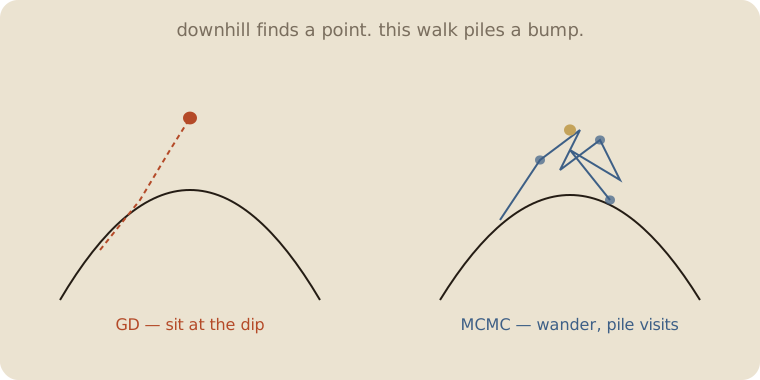
Read 01 prior and 01 gradient descent first. Same eight coins, 3 yes / 5 no. Prior still adds: Beta(4, 6), mean 0.40. This notebook pretends we cannot add, walks anyway, and checks the pile against that bump.
A walk, not a catalog of samplers.
Page 1 — GD sits. This walk piles.
01 gradient descent walks a bowl downhill and stops at a point: ŷ’s leftover² as small as it gets.
The posterior is also a height on knob-land: how much this P likes the coins, times the prior. If you only sit at the peak, you get a point. Bayes wanted a bump — mean and width.
So you walk around, not only down. Visit high places often, low places rarely. After you drop the first stretch, the histogram of visits is a sketch of the posterior — if the walk mixed. Short chain, still a whisper.
People call this Markov chain Monte Carlo. Ugly. Friendly job: wander the bump; the pile is the answer.
On a coin we can add. We walk anyway so you can see the pile match. A slope with a prior usually cannot add. Then this walk is the method, not a demo.
Page 2 — Propose, maybe keep
Stand at a P. Propose a neighbor (a small nudge).
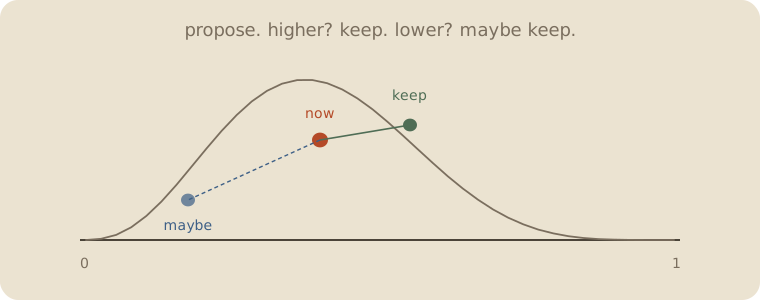
- Higher posterior? Keep it.
- Lower? Keep it with chance = new height / old height. Sometimes go downhill. That is how you still visit the shoulders.
If the neighbor is outside 0–1, stay. Repeat. Throw away the first stretch (you started at 0.5; that was a guess). The rest is the pile — if later steps still wander and do not stick in one pocket.
Quiet nudge: you crawl, accept almost everything. Loud nudge: you jump, reject a lot. Interview stride here: 0.12. Accept rate 0.77. Not a moral.
This flavor is Metropolis. Other walks exist. Same job.
Page 3 — The pile matches the add
Same coins. Flat prior. Height ∝ P³ (1−P)⁵ — three yes, five no.
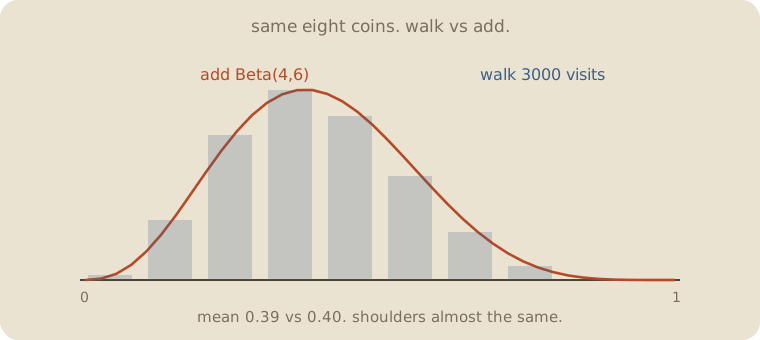
4000 steps, drop the first 1000.
| mean | 5% | 95% | |
|---|---|---|---|
| add Beta(4, 6) | 0.40 | 0.17 | 0.66 |
| walk 3000 visits | 0.39 | 0.17 | 0.65 |
Close enough. Eight coins, a whisper either way. The walk did not need the beta formula. It only needed a height at each P.
That is the gift when you cannot add: if you can score a guess, you can pile guesses.
Page 4 — Mini recipe
- Write a height (log posterior is safer). Prior × how well the data fit this guess.
- Start somewhere legal.
- Propose a neighbor. Keep if higher; maybe keep if lower.
- Repeat a lot. Drop the first stretch.
- The histogram, mean, and shoulders are the posterior.
- If you can add (coin + beta), add. Walk is for when you cannot.
If you keep only one thing:
cannot add? walk the height. the pile is the bump.
Page 5 — Eight coins, walking, in numpy
Same 3 yes, 5 no. Flat prior. Metropolis on P. No extra library.
import numpy as np

yes, no = 3, 5

def log_post(p):
    p = np.clip(p, 1e-9, 1 - 1e-9)
    return yes * np.log(p) + no * np.log(1 - p)

rng = np.random.default_rng(7)
n, step, burn = 4000, 0.12, 1000
p, lp = 0.5, log_post(0.5)
chain = np.empty(n)
acc = 0
for i in range(n):
    q = p + rng.normal(0, step)
    if 0 < q < 1:
        lq = log_post(q)
        if np.log(rng.random()) < lq - lp:
            p, lp = q, lq
            acc += 1
    chain[i] = p
post = chain[burn:]

print("accept rate", round(acc / n, 2))
print("walk mean", round(post.mean(), 3))
print("walk 5%", round(float(np.quantile(post, 0.05)), 3),
      "  95%", round(float(np.quantile(post, 0.95)), 3))

from scipy.stats import beta
d = beta(4, 6)
print("add  mean", round(d.mean(), 3),
      "  5%", round(d.ppf(0.05), 3),
      "  95%", round(d.ppf(0.95), 3))
print("first 8", np.round(chain[:8], 3).tolist())
accept rate 0.77
walk mean 0.39
walk 5% 0.174 95% 0.648
add mean 0.4 5% 0.169 95% 0.655
first 8 [0.5, 0.467, 0.413, 0.42, 0.361, 0.42, 0.432, 0.429]
Start at 0.5, wander. Mean 0.39 vs add 0.40. Shoulders 0.17–0.65 vs 0.17–0.66. First steps already leave 0.5. step is the nudge, not GD’s learning rate — same quiet habit, different job (pile, not dip).
Last page — cheat sheet
| word | meaning |
|---|---|
| height | posterior at this guess (prior × likelihood) |
| propose | a neighbor |
| accept | keep the neighbor (always if higher; maybe if lower) |
| chain | the walk |
| pile | visits after the first stretch = the bump |
| Metropolis | this propose / maybe-keep |
Also called (in a room):
| here | there |
|---|---|
| MCMC | wander the posterior |
| burn-in | drop the first stretch |
| accept rate | how often you moved |
Use / skip
Reach for it when
- you cannot add (no beta-out)
- you still want a bump
- you can score a guess
Skip it when
- coin + beta still adds (01 prior)
- you wanted the dip (01 gradient descent)
- you wanted a catalog of samplers
Pays you: a posterior without a named bump. Same coins, a pile that matches the add — so you trust the walk when add is gone.
Costs you: many steps. A nudge to pick. The first stretch is a lie. Not a point estimate. Not a library.
Bayes 02. Walk the height. Next: 01 the loop — state, action, reward, next. Not a sampler catalog.