Multiple comparisons — a sketchbook
In one sentence
If you ask enough questions, leftover eventually says yes by accident; Bonferroni and Tukey HSD help keep the family’s false alarms under control.
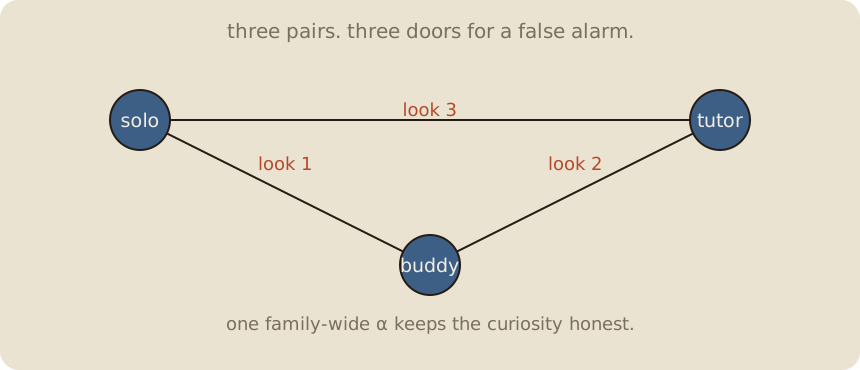
Read 03 ANOVA first. ANOVA told us that at least one of three routines differs. Now we want to ask which pairs without pretending the first raw p was the only look.
Page 1 — One look, one small alarm
At α = 0.05, one test allows a 5% chance of a false alarm when the boring story is true.
That does not mean every p below 0.05 is fake. It means the rule is calibrated for one question under its assumptions.
One question:
Does solo differ from buddy?
One small door for a false alarm.
Page 2 — Three looks open three doors
With solo, buddy, and tutor, there are three pairs:
| pair | raw p |
|---|---|
| solo vs buddy | 0.0135 |
| solo vs tutor | 0.000035 |
| buddy vs tutor | 0.0032 |
If all three boring stories were true, the chance of at least one false alarm is larger than 0.05. A rough independent calculation gives:
The tests are not perfectly independent, so this is a picture, not the final answer. The habit is the point: more looks, more opportunity for leftover to shout.
People call this the family-wise error rate: the chance of one or more false alarms in the family of questions.
Page 3 — Bonferroni brings one α to the family
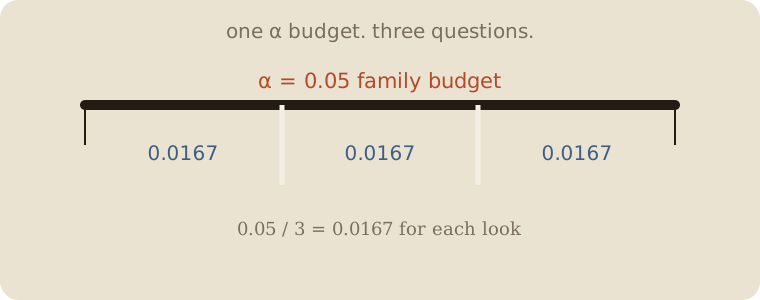
Bonferroni is the blunt, honest haircut:
For three pairs and family α = 0.05:
Or multiply each raw p by three and compare with 0.05. The three adjusted values are 0.0404, 0.000105, and 0.0096.
Bonferroni works for any small list of planned questions. It is easy to explain. It can be conservative: it may miss a real difference when the family gets large.
Page 4 — Tukey knows the all-pairs job
Tukey HSD — honestly significant difference — is made for comparing all pairs of group means after an ANOVA.
It uses the shared within-group wobble and the number of groups together. It asks for one family-wide answer, not three unrelated p values.
For these three piles, Tukey gives:
| pair | mean difference | Tukey p | 95% interval |
|---|---|---|---|
| solo − buddy | −1.125 | 0.0364 | −2.186 to −0.064 |
| solo − tutor | −2.625 | 0.000010 | −3.686 to −1.564 |
| buddy − tutor | −1.500 | 0.0050 | −2.561 to −0.439 |
Every interval stays away from zero here. Each pair survives Tukey’s family-wide guard.
Tukey is not automatically “better” than Bonferroni. It is better matched to the all-pairs question. Bonferroni is the general-purpose haircut.
Page 5 — Alpha does not become a moral score
The error is not that α physically accumulates inside the data. The error is asking many questions while reporting each one as if it were alone.
Call it alpha-error accumulation if you need the phrase. The precise idea is:
the chance of at least one false alarm rises across a family of tests.
Pre-name the family. “We will compare all three routines” is cleaner than trying every split and reporting the one that shouted.
ANOVA first. Then the correction that matches the question.
Page 6 — Mini recipe
- Name the family of questions before looking at the answers.
- Run 03 ANOVA for the overall “any difference?” question.
- If you have a few planned contrasts, use Bonferroni or another planned correction.
- If you want every pair, use Tukey HSD.
- Report the adjusted p, interval, and pair — not only the raw p.
- Do not turn a corrected p into “the effect is true.” It is still an inference under assumptions.
If you keep only one thing:
Many looks need one family-wide guard.
Page 7 — Three routines, protected, in scipy
Same three piles. The run prints raw pairwise p values, Bonferroni values, and Tukey HSD values.
import numpy as np
from scipy import stats

solo = np.array([4, 5, 4, 6, 5, 4, 6, 5], float)
buddy = np.array([5, 6, 6, 7, 6, 5, 7, 6], float)
tutor = np.array([6, 7, 8, 7, 8, 7, 9, 8], float)
groups = [solo, buddy, tutor]
names = ["solo", "buddy", "tutor"]

raw = []
for i in range(3):
    for j in range(i + 1, 3):
        _, p = stats.ttest_ind(groups[i], groups[j], equal_var=True)
        raw.append((names[i], names[j], p))

print("pair                         raw p   Bonferroni p")
for a, b, p in raw:
    print(f"{a:>5} vs {b:<6}          {p:.6f}       {min(3 * p, 1):.6f}")

tukey = stats.tukey_hsd(*groups)
print("Tukey p")
for i in range(3):
    for j in range(i + 1, 3):
        print(names[i], "vs", names[j], f"{tukey.pvalue[i, j]:.6f}")
pair raw p Bonferroni p
solo vs buddy 0.0135 0.0404
solo vs tutor 0.000035 0.000105
buddy vs tutor 0.0032 0.0096
Tukey p
solo vs buddy 0.036372
solo vs tutor 0.000010
buddy vs tutor 0.004988
The raw values look more impressive because they paid no family fee. Bonferroni and Tukey both keep all three pairs below 0.05 here, but the methods answer slightly different questions.
Last page — cheat sheet
| word | meaning |
|---|---|
| family | all tests you are treating as one question set |
| α | allowed family error budget |
| FWER | chance of one or more false alarms in the family |
| Bonferroni | divide α by the number of tests; general-purpose |
| Tukey HSD | all-pairs guard after ANOVA |
| raw p | each test pretending it was alone |
Use / skip
Reach for it when
- ANOVA sent you to specific pairs
- you had several planned questions
- you want to show honest family-wide intervals and p values
Skip it when
- there was only one pre-planned test
- you are using correction as permission to fish forever
- you forgot the overall question that came before the pairs
Pays you: fewer false discoveries from a crowded question list.
Costs you: Bonferroni can be shy; Tukey belongs to all pairs; neither repairs confounding, bad data, or a question invented after the result.
Inference 04. ANOVA found the smoke. Bonferroni and Tukey check the rooms without crying wolf. Next: 05 confidence intervals — name the range’s promise.