Attention — a sketchbook
In one sentence
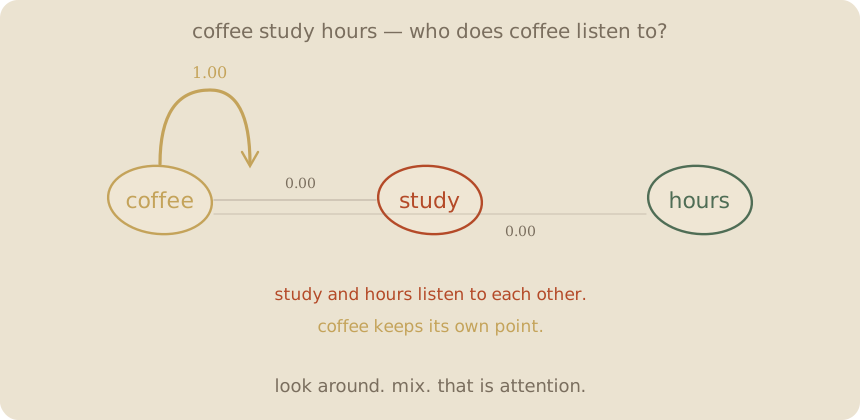
Each token looks around, softmax-shares 1 across the others, then mixes their points. Who matters depends on who is asking.
Read 02 embeddings first. Same exam notes. Same 2-d points. Softmax (03 softmax) is the sharing. The tiny net (01 neural net) still waits after the mix.
This look is all directions — a postcard of mix. An LLM that predicts the next word must look left only (a mask). Positions are extra.
Page 1 — A bag cannot refuse
The note is three words:
coffee study hours
02 embeddings already put them on the page. Coffee down. Study and hours in the huddle.
A blunt next step: average the three points. A bag of words. Everyone gets 1/3, whether they asked or not.
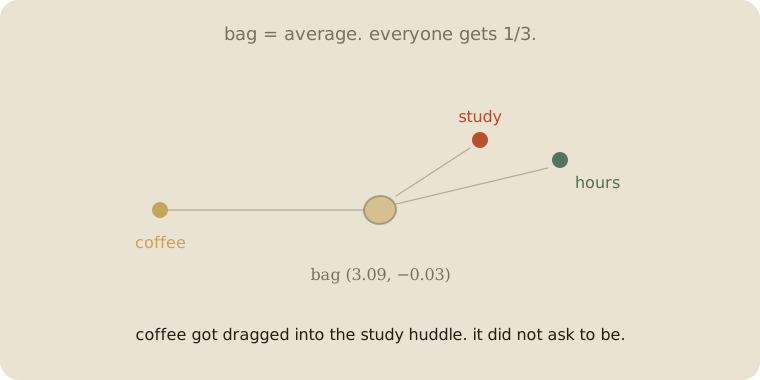
The bag lands at (3.09, −0.03) — in the study huddle. Coffee got dragged. It did not ask to be. If the leftover cares about junk, you just erased it.
Attention is the machine that can refuse.
Page 2 — Look, then share 1
Coffee asks: who here is like me?
Score = how aligned my point is with yours (dot product), quieter by √dim so fat points don’t explode. Then the same squash as 03 softmax: scores in, slices that add to 1.
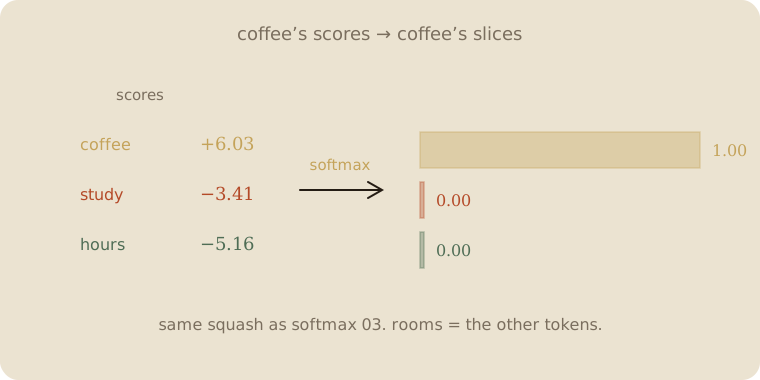
Coffee’s scores: itself +6.03, study −3.41, hours −5.16.
Slices: 1.00 , 0.00 , 0.00.
Study’s slices: 0.00 coffee, 0.05 itself, 0.95 hours. Hours mostly listens to hours. Same note. Three different questions.
People call the slices attention weights. Rooms = the other tokens, not fail / pass / honors.
Page 3 — Mix is a weighted average
Each token keeps a mix of the points it listened to.
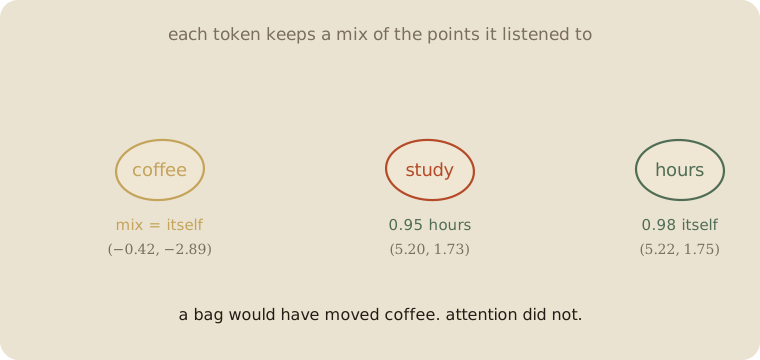
Coffee’s mix is coffee. Study’s mix slides toward hours (5.20, 1.73). Hours stays hours.
A bag moved coffee. Attention did not. That is the gift. Not “understands coffee.” Refuses the wrong neighbor.
The mix is still a point. Then 01 neural net can score → squash as usual.
Page 4 — Ask, match, carry
Three jobs hide in that look:
- query — who do I need?
- key — here I am
- value — what I hand over
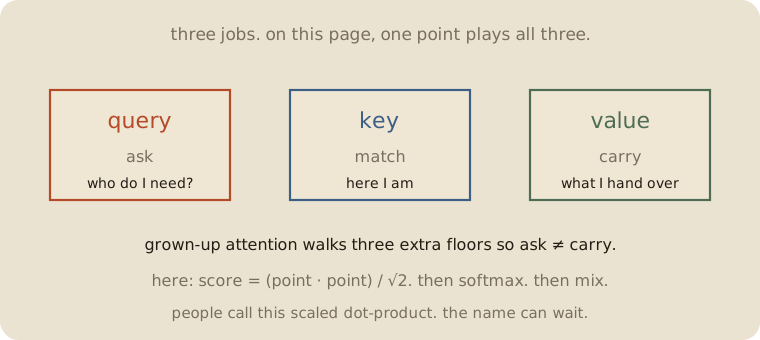
On this page, one point plays all three. Grown-up attention walks three extra floors so ask ≠ carry. Same leftover, more knobs.
Score = (query · key) / √dim. Softmax. Mix the values. People call this scaled dot-product. The name can wait.
Many heads = many looks in parallel (study-vs-junk, grammar, …). Later page. One head is the brick.
Page 5 — Mini recipe
- Tokens already have points (02 embeddings). Hours as a number? Skip this notebook.
- Each token looks at the others (dot, then /√dim).
- Softmax → slices add to 1. Same squash as 03.
- Mix the points (or the values) with those slices.
- Then the tiny net. Then leftover walks home.
- A mean of the note was enough? You stacked a look for sport.
If you keep only one thing:
look around. share 1. mix. who matters depends on the asker.
Page 6 — Coffee study hours, in numpy
Same 27 notes, same 2-d table as 02 embeddings. One sentence. No sklearn estimator — the look is the lesson.
import numpy as np
from sklearn.feature_extraction.text import CountVectorizer
from sklearn.decomposition import PCA

notes = [
    "study hours textbook",
    "hours study tutor exam",
    "textbook hours cram",
    "tutor study hours",
    "cram textbook study night",
    "hours textbook tutor",
    "study cram hours exam",
    "tutor textbook hours",
    "exam study textbook",
    "night cram hours",
    "sleep rest tired",
    "rest sleep bed",
    "tired sleep rest night",
    "bed rest sleep",
    "sleep tired bed",
    "rest bed tired",
    "sleep night rest",
    "coffee phone scroll",
    "phone coffee noise",
    "noise hallway coffee",
    "coffee noise hallway",
    "phone scroll coffee",
    "scroll phone instagram",
    "study sleep hours",
    "coffee study hours",
    "tutor sleep rest",
    "night exam coffee",
]

vec = CountVectorizer()
X = vec.fit_transform(notes).toarray()
words = np.array(vec.get_feature_names_out())
C = X.T @ X
np.fill_diagonal(C, 0)
E = PCA(n_components=2, random_state=7).fit_transform(C)
idx = {w: i for i, w in enumerate(words)}

sent = ["coffee", "study", "hours"]
Xw = np.stack([E[idx[w]] for w in sent])
scale = np.sqrt(Xw.shape[1])
scores = (Xw @ Xw.T) / scale
ex = np.exp(scores - scores.max(1, keepdims=True))
W = ex / ex.sum(1, keepdims=True)
mix = W @ Xw

print("tokens", sent)
print("points")
print(np.round(Xw, 2))
print("bag mean", np.round(Xw.mean(0), 2))
print("weights")
print(np.round(W, 2))
print("mix")
print(np.round(mix, 2))
tokens ['coffee', 'study', 'hours']
points
[[-0.42 -2.89]
[ 4.46 1.02]
[ 5.23 1.77]]
bag mean [ 3.09 -0.03]
weights
[[1. 0. 0. ]
[0. 0.05 0.95]
[0. 0.02 0.98]]
mix
[[-0.42 -2.89]
[ 5.2 1.73]
[ 5.22 1.75]]
Coffee’s row is 1.00 on coffee. The mix is still (−0.42, −2.89). The bag had already smeared it to (3.09, −0.03). Study mostly listens to hours (0.95) — same huddle, as 02 embeddings promised (cosine 0.99).
This is self-attention with one head and no extra Q/K/V floors. An LLM walks those floors, stacks the block, and softmaxes the next token. The look is already this page.
Last page — cheat sheet
| word | meaning |
|---|---|
| look / score | (query · key) / √dim |
| weights | softmax of the scores; add to 1 |
| mix | weighted average of values |
| query / key / value | ask / match / carry |
| bag | mean of the points; cannot refuse |
| self-attention | tokens looking at this note |
Also called (in a room):
| here | there |
|---|---|
| look | attention scores |
| mix | weighted average of values |
| bag | mean pooling |
Use / skip
Reach for it when
- a bag would smear the wrong neighbor
- who matters depends on the asker
- tokens already have points
Skip it when
- hours already is one number (01 neural net)
- a mean of the note was enough
- you wanted a transformer as the first file
Pays you: a look that can refuse. The brick inside every transformer. Softmax you already own, pointed at other tokens.
Costs you: every token looks at every token (n²). Extra Q/K/V knobs. One head on 2-d notes is a postcard. Pattern of looking, not understanding.
Nets wing, 03. Look, share 1, mix. Next room: 04 LLM — this block, stacked, trained on the next token.