Gradient boosting — a sketchbook
In one sentence
Trees in a line, not a choir: each new tree is trained on the leftover mistakes. Add them quietly (learning rate). That is boosting.
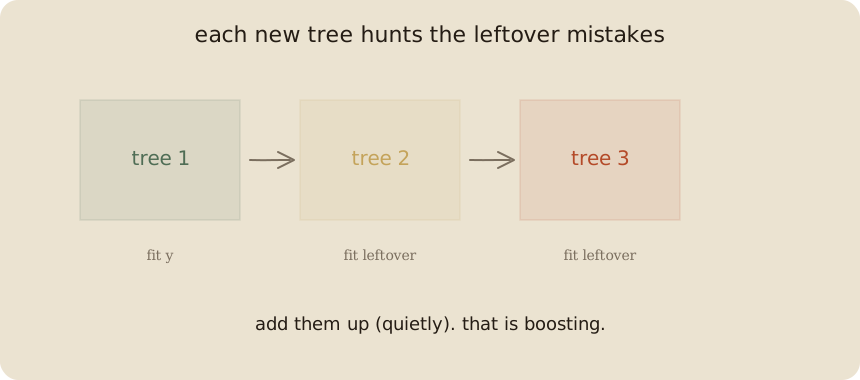
Read 01 decision tree and 02 random forest first. Same exam. Forest: many trees in parallel, then a vote. Boosting: many trees in sequence, each fixing what the last still got wrong.
XGBoost / LightGBM / CatBoost are fast, taxed versions of this idea. The religion is here. The brand names are engines. Dialects in one page: 04 boosting flavors.
Page 1 — Choir vs chain
Forest: disagreement by bagging and muted levers. Vote.
Boosting: no vote at the start. Tree 1 fits y (pass/fail, or a score). Look at who is still wrong — the leftover. Tree 2 fits that leftover. Tree 3 fits the leftover of 1+2. Add them up.
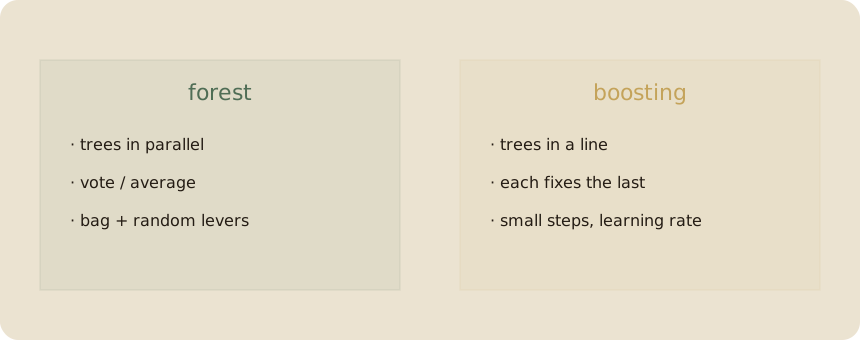
| forest | boosting | |
|---|---|---|
| trees | parallel | a chain |
| each tree sees | a bag of y | the current leftover |
| combine | vote / average | sum (small steps) |
| randomness | the point | optional extra |
Same bricks (shallow trees). Different glue.
Page 2 — Leftover is not a 0/1 miss
You have met leftovers: y − ŷ on the grade line.
Pass/fail is the same verb, not “tree 2 refits 0 or 1.” Tree 1 puts out a score. Squash to P(pass). Leftover = y − P. That is the downhill of the loss (the negative gradient). Tree 2 walks that way. Hence the name.
They failed (y = 0). Tree 1 still said score +0.5 → P ≈ 0.62. Leftover = 0 − 0.62 = −0.62. Tree 2 fits that pull toward fail — not a second binary label.
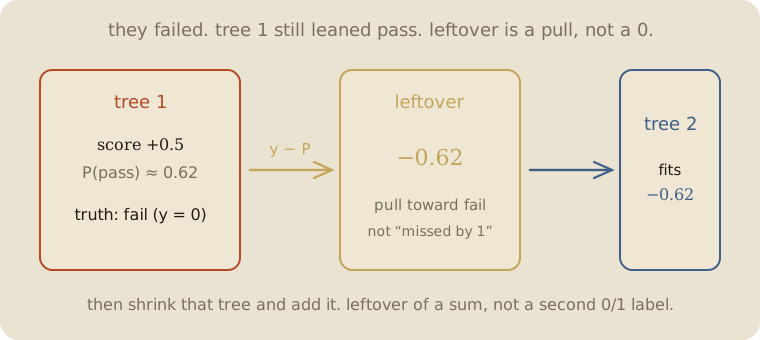
Then shrink that tree before adding it. If you add it at full volume, tree 2 memorizes the noise of tree 1’s leftover. That is overfit, only faster.
Page 3 — Learning rate is the volume knob
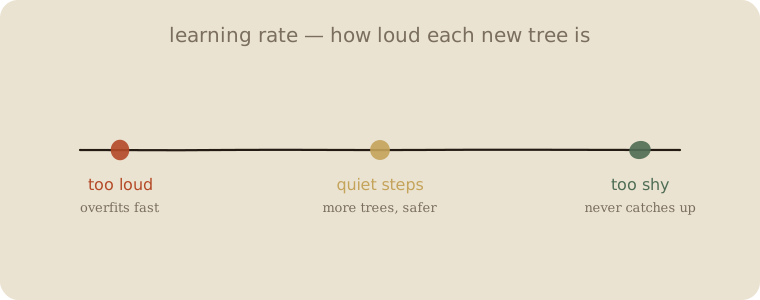
Learning rate (ν, sklearn learning_rate): how much of each new tree you actually add.
| too loud (≈ 1) | quiet (0.05–0.1) | too shy |
|---|---|---|
| few trees, overfits fast | more trees, safer | never catches up |
Rule of thumb: smaller rate, more trees. You buy the same fit in smaller bites. Ridge energy: a tax on drama, paid in steps.
Depth of each tree is usually small (stumps or depth 2–3). The chain supplies the complexity, not one deep monster.
Page 4 — Same pass/fail class, honestly
The forest lifted test from 0.71 → 0.79. Boosting on this tiny exam is easy to spoil:
| model | knobs | train | test |
|---|---|---|---|
| deep tree | depth 8 | 1.000 | 0.708 |
| forest | 100 trees | 1.000 | 0.792 |
| boosting | rate 0.1, 30 trees, depth 2 | 0.964 | 0.750 |
| boosting | rate 1.0, 30 trees | 1.000 | 0.750 |
| boosting | rate 0.1, 80 trees | 1.000 | 0.708 |
| boosting | rate 0.05, 40 trees, depth 3 | 1.000 | 0.667 |
Quiet + short chain: a bit better than the deep tree, not better than the forest, on 24 test people. Longer chain: train perfect, test back to 0.71 — memorized again. Deeper bricks + quieter rate is not a free swap: test 0.667. Same class, worse.
That is the lesson, not a scandal. Boosting shines on bigger tables. On this toy exam the choir is enough. Importances still hours-first (~0.83), then sleep, tutor whisper.
If you later open XGBoost: same leftover-chain + extra taxes (shrinkage, column samples, regularizers). Different engine, same religion.
Page 5 — Mini recipe
- Know one tree (Gini, leftover as a room).
- Fit a small tree to y (or to the score).
- Compute leftover = y − P (not a 0/1 miss). Fit the next small tree to that.
- Add it quietly (
learning_rate). - Repeat. Stop when hidden people stop improving — more trees can hurt.
- Do not start at XGBoost. Start here. Then change the engine if you need speed.
If you keep only one thing:
forest votes. boosting adds leftover-trees, quietly.
Page 6 — The chain, in sklearn
Same pass/fail class as the forest notebook — eighty students. GradientBoostingClassifier is the plain sklearn chain (not XGBoost). Depth 2 trees.
import numpy as np
from sklearn.model_selection import train_test_split
from sklearn.ensemble import GradientBoostingClassifier, RandomForestClassifier
from sklearn.tree import DecisionTreeClassifier

rng = np.random.default_rng(7)
n = 80
hours = rng.uniform(1, 6, n)
sleep = rng.uniform(4, 9, n)
tutor = (rng.random(n) > 0.6).astype(float)
z = -3.2 + 1.05 * hours + 0.25 * (sleep - 6.5) + 0.7 * tutor
passed = (rng.random(n) < 1 / (1 + np.exp(-z))).astype(int)

X = np.column_stack([hours, sleep, tutor])
names = ["hours", "sleep", "tutor"]
Xtr, Xte, ytr, yte = train_test_split(X, passed, test_size=0.3, random_state=0)

deep = DecisionTreeClassifier(max_depth=8, random_state=7).fit(Xtr, ytr)
rf = RandomForestClassifier(n_estimators=100, random_state=7).fit(Xtr, ytr)
gb = GradientBoostingClassifier(
    n_estimators=30, learning_rate=0.1, max_depth=2, random_state=7
).fit(Xtr, ytr)

print("deep   ", round(deep.score(Xtr, ytr), 3), round(deep.score(Xte, yte), 3))
print("forest ", round(rf.score(Xtr, ytr), 3), round(rf.score(Xte, yte), 3))
print("boost  ", round(gb.score(Xtr, ytr), 3), round(gb.score(Xte, yte), 3))
print("importances", dict(zip(names, gb.feature_importances_.round(3))))
deep 1.0 0.708
forest 1.0 0.792
boost 0.964 0.75
importances {'hours': 0.831, 'sleep': 0.15, 'tutor': 0.019}
On this small test set the forest wins. That does not mean boosting is weaker. It means 56 trainers + a chain is easy to spoil. Boosting is the chain you will want when n grows and you are willing to tune rate × trees. The printout is the honesty, not a demo that boosting always beats the choir.
n_estimators = length of the chain. learning_rate = how loud each new tree is. max_depth=2 keeps each brick small.
Last page — cheat sheet
| word | meaning |
|---|---|
| leftover / gradient | y − P (pass/fail), not a second 0/1 label |
| chain | tree k fits the leftover of 1…k−1 |
| learning rate | shrink each tree before adding |
| n_estimators | how many leftover-trees |
| XGBoost etc. | engines for this religion |
Use / skip
Reach for it when
- tables with mixes, leftover errors that a forest already almost got
- you will tune rate and depth
- you outgrew one default forest
Skip it when
- you need an answer tonight with no knobs (02 random forest)
- tiny n and a loud rate (you will memorize)
- a line or logistic already fits
Pays you: often the strongest tabular model once n is real. Fine leftover-hunting. Same bricks as the tree notebook.
Costs you: knobs. Easy to overfit. Harder to read than one tree. On 80 fake students the forest was enough — believe the test set, not the brand.
The chain. Forest was the choir: 02 random forest. AdaBoost vs XGBoost vs this, in one page: 04 boosting flavors.