Train / test / validate — a sketchbook
In one sentence
Fit on some people. Score leftover on people the machine has not seen. Scoring the same pile you fitted is pride, not a test. If you also tune a knob, hide a third pile so the test stays honest.
Any machine. A line, a tree, a tax. The ritual is the same. The numbers below are one class of thirty — grades from hours, sleep, tutor — so you can see the gap.
Page 1 — The job is the next person
You can fit on everyone and print a score. It will look grown-up. It used every leftover twice: once to draw the machine, once to clap for it.
The job is not “look smart on the people you already asked.”
The job is: guess well for the next person.
Hide some. Fit on the rest. Score the hidden ones. That is train vs test. Not a new machine. A ritual for leftover.
The pages below use thirty graders so the numbers are real. Same ritual for a tree, a net, a tax.
Page 2 — Pride is not a test
Fit a line on all thirty. Score all thirty.
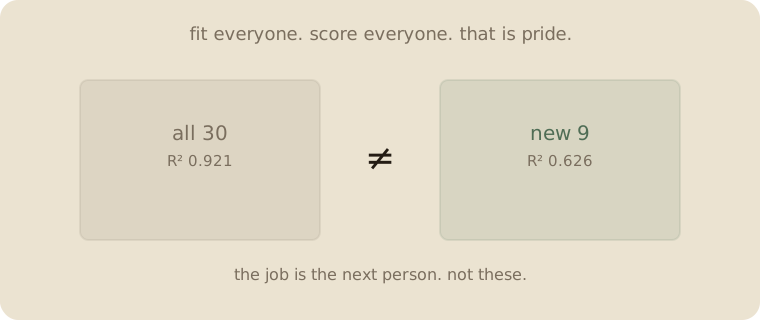
R² 0.921. Pride.
Hide 9. Fit on 21. Score the 9.
| pile | people | R² |
|---|---|---|
| all 30 (pride) | 30 | 0.921 |
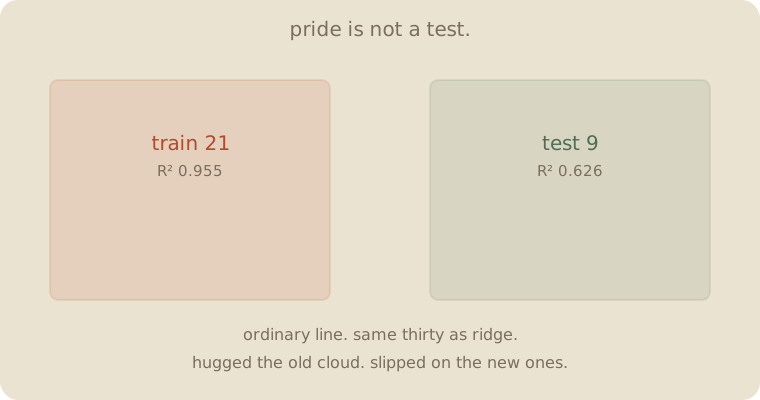
| train | 21 | 0.955 |
| test | 9 | 0.626 |
The machine hugged the trainers (0.955). The 9 had not voted. 0.626. That gap is the lesson. 21 and 9 are this split, not a law.
sklearn’s train_test_split is that hide.
Page 3 — Do not peek
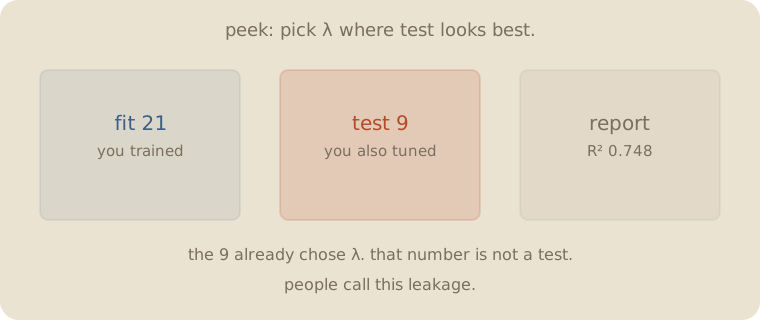
If you tune a knob — how loud a tax, how deep a tree — temptation: try a few, keep the one where test looks best. The tables use a tax’s volume (sklearn alpha). Same sin for any knob.
α (sklearn alpha = λ) | train R² | test R² |
|---|---|---|
| 1 | 0.944 | 0.706 |
| 3 | 0.939 | 0.731 |
| 10 | 0.907 | 0.748 |
| 30 | 0.780 | 0.672 |
Picked 10. Report 0.748. Looks like the tax won.
The 9 already chose the knob. That number is not a test. People call this leakage. Same sin as shuffling weeks into a “test” set (01 lag trend season). The future voted on the knobs.
Page 4 — Three piles
Hide the 9 and do not touch them until the end.
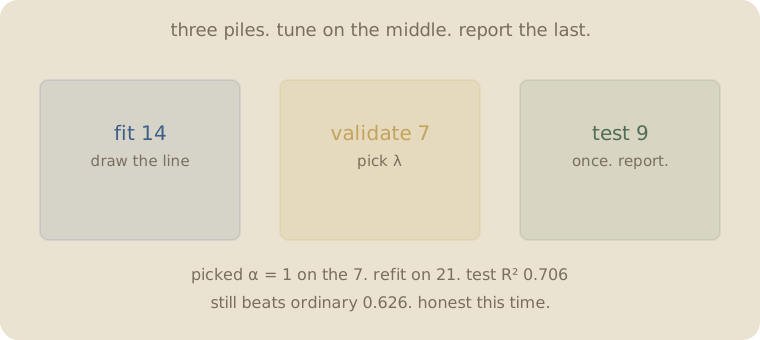
From the 21, hide 7 more. Fit on 14. Pick the knob on the 7. Then refit the winner on all 21. Then score the 9. Once.
| pile | people | job |
|---|---|---|
| fit | 14 | draw the line |
| validate | 7 | pick the knob |
| test | 9 | report. once. |
On the 7, α = 1 wins (val R² 0.736). α = 10, the peek’s darling, is 0.647 on this hide.
Refit α = 1 on the 21. Test R² 0.706. Still beats ordinary 0.626. Honest this time.
Seven people is a thin judge. The number wiggles. That is why the next page exists.
Page 5 — Rotate the hide
Too few to split three ways? Keep the 9 in a drawer. On the 21, hide a third, fit the rest, score the hide. Rotate. Average the pain.
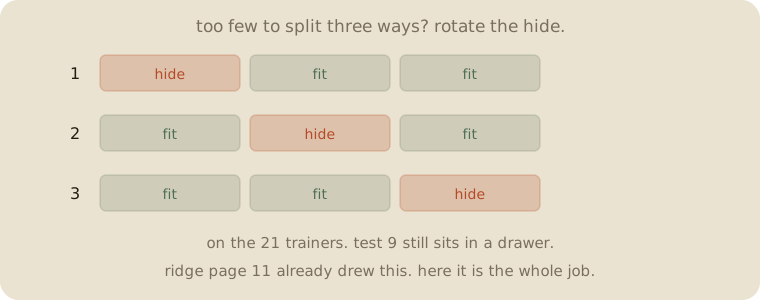
That ritual is cross-validation. Here it is the whole job, not an aside.
3-fold CV on the 21 (test still untouched):
| α | CV mean | the three hides |
|---|---|---|
| 1 | 0.702 | 0.985 / 0.864 / 0.259 |
| 3 | 0.683 | 0.986 / 0.845 / 0.218 |
| 10 | 0.522 | 0.954 / 0.698 / −0.084 |
| 30 | 0.070 | 0.786 / 0.35 / −0.925 |
Picked 1 again. Refit on 21. Test 0.706. Same report as the one validate pile, more stable pick.
One fold went 0.259. Seven-ish people, leftover rattles. Average anyway. Do not throw out the ritual because one hide was ugly.
Time is a different hide: last weeks, not a shuffle (01 lag trend season).
Page 6 — Mini recipe
- Hide people before you fit. That pile is test. Do not look.
- Fit on the rest. Score both piles. Train high, test low → you hugged the old cloud.
- If you pick a knob (volume, depth, k): you need a third pile, or rotate the hide on the trainers (CV).
- Refit the winner on all trainers. Score test once.
- Time: last weeks are the test. Not a random 30%.
- Do not call R² on the trainers a result. That is pride.
If you keep only one thing:
leftover on new people. if you tune, hide a third pile.
Page 7 — Thirty graders, in sklearn
Thirty graders. Same split as the tables above. Ordinary hugs. Peek vs three piles vs CV.
import numpy as np
from sklearn.linear_model import LinearRegression, Ridge
from sklearn.model_selection import train_test_split, KFold
from sklearn.pipeline import make_pipeline
from sklearn.preprocessing import StandardScaler

rng = np.random.default_rng(7)
n = 30
hours = rng.uniform(1, 6, n)
sleep = rng.uniform(4, 9, n)
tutor = (rng.random(n) > 0.6).astype(float)
coffee = rng.uniform(0, 4, n)
noise = rng.normal(0, 1, n)
minutes = hours * 60 + rng.normal(0, 3, n)
naps = sleep + rng.normal(0, 0.25, n)
grade = 1.8 + 0.9 * hours + 0.35 * sleep + 0.6 * tutor + rng.normal(0, 0.55, n)
X = np.column_stack([hours, minutes, sleep, naps, tutor, coffee, noise])
Xtr, Xte, ytr, yte = train_test_split(X, grade, test_size=0.3, random_state=0)

print("n", n, "train", len(ytr), "test", len(yte))

ols = LinearRegression().fit(Xtr, ytr)
print("ordinary  R² train", round(ols.score(Xtr, ytr), 3),
      "  R² test", round(ols.score(Xte, yte), 3))
print("ordinary  R² all 30", round(LinearRegression().fit(X, grade).score(X, grade), 3))

print("\npeek — pick λ on the test pile")
best_te, best_a = -1, None
for a in [1, 3, 10, 30]:
    r = make_pipeline(StandardScaler(), Ridge(alpha=a)).fit(Xtr, ytr)
    te = r.score(Xte, yte)
    print(f"  alpha={a:<3}  R² train {r.score(Xtr, ytr):.3f}  R² test {te:.3f}")
    if te > best_te:
        best_te, best_a = te, a
print("picked on test:", best_a)

Xfit, Xva, yfit, yva = train_test_split(Xtr, ytr, test_size=7, random_state=0)
print("\nhonest — 14 fit / 7 validate / 9 test")
best_va, best_a = -1, None
for a in [1, 3, 10, 30]:
    r = make_pipeline(StandardScaler(), Ridge(alpha=a)).fit(Xfit, yfit)
    va = r.score(Xva, yva)
    print(f"  alpha={a:<3}  R² fit {r.score(Xfit, yfit):.3f}  R² val {va:.3f}")
    if va > best_va:
        best_va, best_a = va, a
print("picked on val:", best_a)
win = make_pipeline(StandardScaler(), Ridge(alpha=best_a)).fit(Xtr, ytr)
print("refit on 21, R² test", round(win.score(Xte, yte), 3))

print("\n3-fold CV on the 21 (no test)")
kf = KFold(n_splits=3, shuffle=True, random_state=7)
best_cv, best_a = -1, None
for a in [1, 3, 10, 30]:
    scores = []
    for ti, vi in kf.split(Xtr):
        r = make_pipeline(StandardScaler(), Ridge(alpha=a)).fit(Xtr[ti], ytr[ti])
        scores.append(r.score(Xtr[vi], ytr[vi]))
    mu = float(np.mean(scores))
    print(f"  alpha={a:<3}  CV {mu:.3f}  folds {np.round(scores, 3).tolist()}")
    if mu > best_cv:
        best_cv, best_a = mu, a
print("picked on CV:", best_a)
win = make_pipeline(StandardScaler(), Ridge(alpha=best_a)).fit(Xtr, ytr)
print("refit on 21, R² test", round(win.score(Xte, yte), 3))
n 30 train 21 test 9
ordinary R² train 0.955 R² test 0.626
ordinary R² all 30 0.921
peek — pick λ on the test pile
alpha=1 R² train 0.944 R² test 0.706
alpha=3 R² train 0.939 R² test 0.731
alpha=10 R² train 0.907 R² test 0.748
alpha=30 R² train 0.780 R² test 0.672
picked on test: 10
honest — 14 fit / 7 validate / 9 test
alpha=1 R² fit 0.956 R² val 0.736
alpha=3 R² fit 0.948 R² val 0.731
alpha=10 R² fit 0.899 R² val 0.647
alpha=30 R² fit 0.737 R² val 0.444
picked on val: 1
refit on 21, R² test 0.706
3-fold CV on the 21 (no test)
alpha=1 CV 0.702 folds [0.985, 0.864, 0.259]
alpha=3 CV 0.683 folds [0.986, 0.845, 0.218]
alpha=10 CV 0.522 folds [0.954, 0.698, -0.084]
alpha=30 CV 0.070 folds [0.786, 0.35, -0.925]
picked on CV: 1
refit on 21, R² test 0.706
Pride 0.921. Train 0.955, test 0.626 — ordinary hugged. Peek picked α = 10 and would have reported 0.748. Three piles and CV both pick 1, then report 0.706 on the 9. sklearn’s alpha is the volume knob. KFold is the rotate. The test array is not an argument to KFold.
Last page — cheat sheet
| word | meaning |
|---|---|
| train | people you fit on |
| test | people you score once, at the end |
| validate | people you use to pick the knob |
| pride | score on the people you fit |
| leakage | test helped pick the knobs |
| CV | rotate the validate hide on the trainers |
Also called (in a room):
| here | there |
|---|---|
| train/test | holdout |
| validate | development set |
| CV | k-fold |
| peek | test-set tuning |
Use / skip
Reach for it when
- you will report a number
- you will pick a knob
- the job is the next person
Skip it when
- eight people and one line is a demo (pride on purpose)
- you already peeked
- the “new people” are later in time — last weeks, not a shuffle (01 lag trend season)
Pays you: leftover that means something. A knob you can defend.
Costs you: fewer people to fit. A thin validate pile rattles. CV is slower. Not a model — a ritual for leftover.
Leftover on new people. Next: 02 bias variance — jumpy vs shy. Metrics after that.