Bias vs variance — a sketchbook
In one sentence
Variance is how much the line jumps if you redraw the people. Bias is how much it sits systematically off. You buy one with the other.
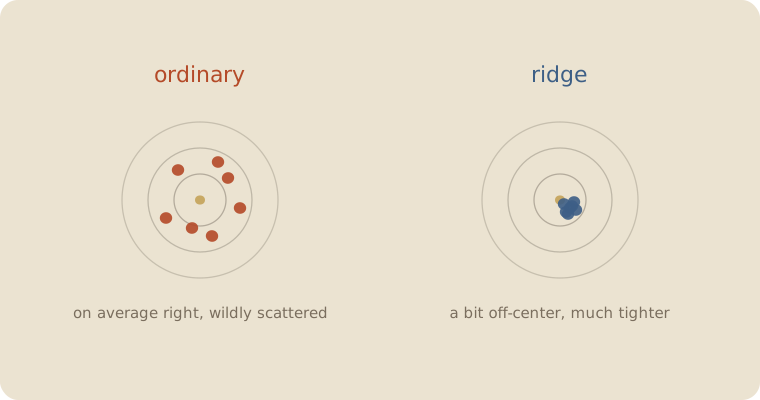
Read 01 train test validate first. Same thirty graders. This notebook names the gap: jumpy vs shy.
Page 1 — The gap has a name
01 train test validate hid 9 people. Ordinary: train R² 0.955, test 0.626.
That gap is not “the model is bad.” It is two different sins that look the same on one split:
- the line hugged this 21 (jumpy — another 21 would have hugged differently)
- or the line is systematically shy (off-center on every 21)
People call the jump variance. The shy sit bias.
A wild machine: darts fly everywhere, on average near the bullseye. A calmer one: darts cluster, a bit off-center. Same trade. This page puts numbers on it. The calm machine in the tables is a tax on huge slopes (02 ridge regression) — a worked example, not homework.
Page 2 — Variance is the jump
Redraw the 21 / 9 split forty times. Same thirty people. Different hide. Fit ordinary. Read hours b.
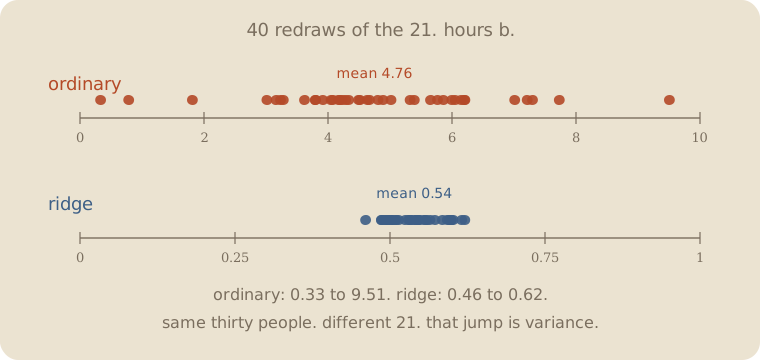
Ordinary hours b: mean 4.76, sd 1.77, from 0.33 to 9.51.
That is not a slope. That is a fight with minutes, a new winner every redraw. Net effect still ≈ 0.93 grade per extra hour — a cancellation. The story jumps. That jump is variance.
A tax (scaled, α = 10): hours b mean 0.54, sd 0.04, from 0.46 to 0.62.
Different units (scaled). Same lesson: the pile is tight. Redraw the 21, get almost the same knob.
Hours-only, no twins: b mean 0.96, sd 0.05. Calm. One honest x did not need a tax.
Page 3 — Bias is the shy sit
The calm pile is not on the ordinary mean. It is smaller on purpose. The tax pulls knobs toward zero. Every redraw, a little shy.
That systematic miss is bias. Not a moral. A choice: sit off-center so you do not fly.
Hours-only is the other shy: it never sees sleep or tutor. Calm knobs, a bit simple. Test R² mean 0.70 — less than ordinary’s mean 0.79, and ordinary’s worst redraw is 0.54.
Ordinary: better on average, uglier on a bad hide. The tax: a bit worse on average (test mean 0.77), less of a disaster (worst 0.60).
You are not trying to be unbiased and heroic. You are trying not to flail.
Page 4 — You buy one with the other
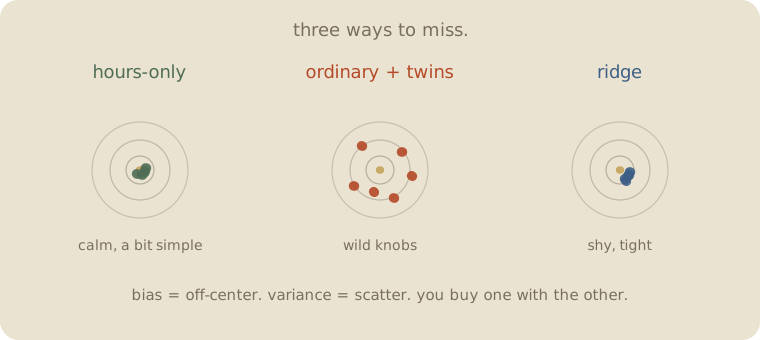
| machine | bias | variance | vibe |
|---|---|---|---|
| hours-only | a bit high (sleep ignored) | low | calm, simple |
| ordinary + twins | low on average | high | wild knobs |
| tax (calm) | a bit high (shy) | low | tight pile |
There is no free dart in the bullseye every time. A deep tree hugs (variance). A stump is shy (bias). A forest votes the hug away (02 random forest). Same dartboard, different machine.
01 train test validate is how you see leftover on new people. This notebook is which leftover you bought.
Page 5 — Mini recipe
- Redraw the hide (or the people). Fit again. Look at the knobs.
- If they fly — variance. Tax, stump, or more people.
- If they sit still but off — bias. The machine is too shy or too simple.
- Do not hunt zero bias. Hunt leftover on people you have not seen.
- One honest x, plenty of people: skip the sermon.
If you keep only one thing:
jumpy knobs = variance. shy sit = bias. you buy one with the other.
Page 6 — Forty hides, in sklearn
Same thirty as 01 train test validate. 40 different 21 / 9 splits. Ordinary hours b vs a tax on huge slopes (scaled, α = 10).
import numpy as np
from sklearn.linear_model import LinearRegression, Ridge
from sklearn.model_selection import train_test_split
from sklearn.pipeline import make_pipeline
from sklearn.preprocessing import StandardScaler

rng = np.random.default_rng(7)
n = 30
hours = rng.uniform(1, 6, n)
sleep = rng.uniform(4, 9, n)
tutor = (rng.random(n) > 0.6).astype(float)
coffee = rng.uniform(0, 4, n)
noise = rng.normal(0, 1, n)
minutes = hours * 60 + rng.normal(0, 3, n)
naps = sleep + rng.normal(0, 0.25, n)
grade = 1.8 + 0.9 * hours + 0.35 * sleep + 0.6 * tutor + rng.normal(0, 0.55, n)
X = np.column_stack([hours, minutes, sleep, naps, tutor, coffee, noise])

ols_h, rd_h, ols_te, rd_te, only_b, only_te = [], [], [], [], [], []
for s in range(40):
    Xtr, Xte, ytr, yte = train_test_split(X, grade, test_size=0.3, random_state=s)
    ols = LinearRegression().fit(Xtr, ytr)
    rd = make_pipeline(StandardScaler(), Ridge(alpha=10)).fit(Xtr, ytr)
    ols_h.append(ols.coef_[0])
    rd_h.append(rd.named_steps["ridge"].coef_[0])
    ols_te.append(ols.score(Xte, yte))
    rd_te.append(rd.score(Xte, yte))
    Htr, Hte, ytr2, yte2 = train_test_split(
        hours.reshape(-1, 1), grade, test_size=0.3, random_state=s
    )
    m = LinearRegression().fit(Htr, ytr2)
    only_b.append(m.coef_[0])
    only_te.append(m.score(Hte, yte2))

def row(title, a):
    a = np.array(a)
    print(f"{title:20s}  mean {a.mean():6.3f}   sd {a.std(ddof=1):5.3f}   "
          f"min {a.min():6.3f}   max {a.max():6.3f}")

print("40 redraws of 21 / 9")
row("OLS hours b", ols_h)
row("ridge hours (sc.)", rd_h)
row("OLS test R²", ols_te)
row("ridge test R²", rd_te)
row("hours-only b", only_b)
row("hours-only test R²", only_te)
40 redraws of 21 / 9
OLS hours b mean 4.762 sd 1.773 min 0.333 max 9.506
ridge hours (sc.) mean 0.541 sd 0.041 min 0.461 max 0.621
OLS test R² mean 0.788 sd 0.102 min 0.540 max 0.925
ridge test R² mean 0.772 sd 0.083 min 0.601 max 0.941
hours-only b mean 0.958 sd 0.052 min 0.864 max 1.102
hours-only test R² mean 0.698 sd 0.156 min 0.304 max 0.914
Ordinary hours b spans nine points. The tax’s scaled hours b stays in a 0.16 window. Test R²: ordinary mean a hair higher, worst hide uglier (0.54 vs 0.60). Hours-only b is calm (0.96, planted 0.9) and loses on test because sleep and tutor never got a knob.
alpha=10 is one loud tax, not an honest pick from 01 train test validate. The dartboard does not care. sd is the jump. mean vs planted is the sit.
Last page — cheat sheet
| word | meaning |
|---|---|
| variance | knobs jump when the people jump |
| bias | knobs sit off, every redraw |
| trade | shy vs jumpy — you buy one with the other |
| redraw | new train/test hide, same thirty |
Also called (in a room):
| here | there |
|---|---|
| jumpy | high variance |
| shy | high bias |
| hug the trainers | overfit |
Use / skip
Reach for it when
- train is high and test is low
- knobs jump if you redraw
- you are choosing shy vs jumpy
Skip it when
- one honest x and plenty of people (hours-only was already calm)
- you wanted a p (01 t-test)
- you wanted precision / recall (03 metrics)
Pays you: a name for the gap on 01 train test validate. Jumpy vs shy, as a habit.
Costs you: not two numbers off one fit. You need redraws, or a story (twins, a tax, a stump).
Fundamentals 02. Jumpy vs shy. Next: 03 metrics — when accuracy lies. Not a p-value.