t-test — a sketchbook
In one sentence
A t-test asks: could leftover have faked this number? Loud leftover → quiet t. Quiet leftover vs a steep slope → loud t. p is how often leftover is that loud.
Read 01 distributions first, and the eight grades on 01 linear regression. Same people. Same line ŷ = 1.75 + 1 · hours. The new question is not ŷ. It is is this real?
Page 1 — Two questions, one class
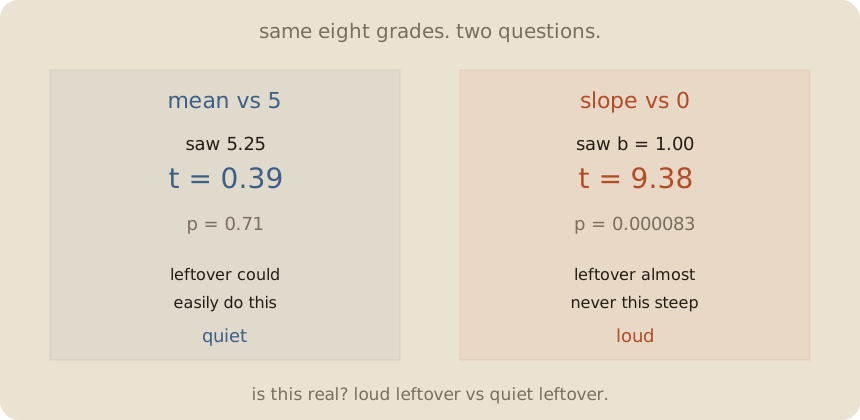
Eight grades. Mean 5.25. Slope b = 1.
Question A: is the mean different from 5 — a boring “about average” story?
Question B: is the slope different from 0 — a boring “hours do nothing” story?
Same leftover costume: a bell (01 distributions). Same eight dots. The answers will not match. That is the point of the notebook.
Page 2 — Signal over rattle
You saw a number. Leftover rattles every number. Divide:
se is how much leftover usually shoves that number. Mean: se = sd / √n. Slope: a similar rattle, from the leftovers of the line.
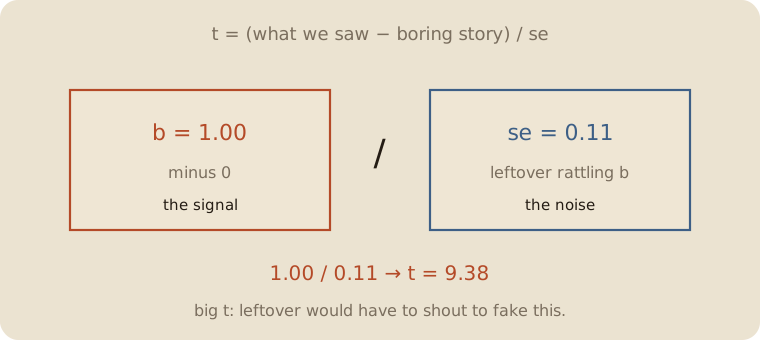
Mean vs 5: (5.25 − 5) / 0.65 → t = 0.39. Tiny.
Slope vs 0: 1.00 / 0.11 → t = 9.38. Huge.
People call se the standard error. Not the leftover’s sd. The leftover’s sd for this knob, after eight people.
Page 3 — If the boring story is true, t sits near 0
Draw leftover’s favorite ts. A bell, a bit fatter than a z because eight people is not infinity. z is the same ratio when you already know σ and n is huge. Here you guess σ from the eight — so the tail is fatter. That extra fat is t.
Degrees of freedom = leftovers you still own after you spent knobs. Mean: you spent ȳ, so n − 1 = 7. Slope: you spent a and b, so n − 2 = 6. Spend more knobs, fatter t, louder leftover needed to look “real.”
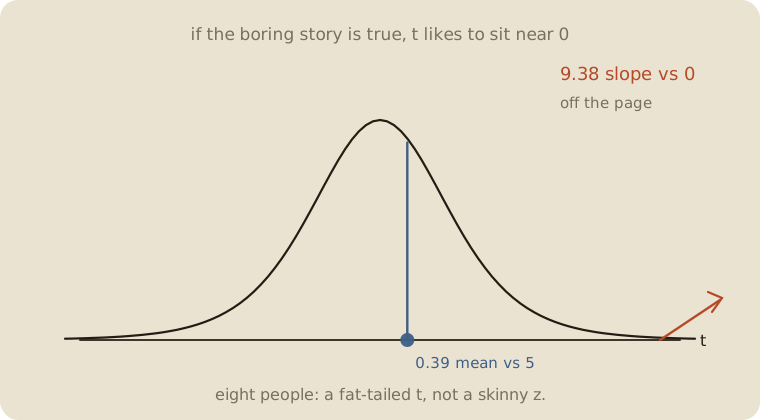
0.39 sits in the fat middle. Leftover does this all day.
9.38 is off the page. If hours did nothing, leftover almost never draws a line this steep.
The costume still matters. Coin y is not this bell. Counts are not this bell. Wrong costume → smug t.
Page 4 — p is the tail, not a verdict
p = how often leftover is this loud, or louder, if the boring story is true. Both tails: we did not bet on the sign.
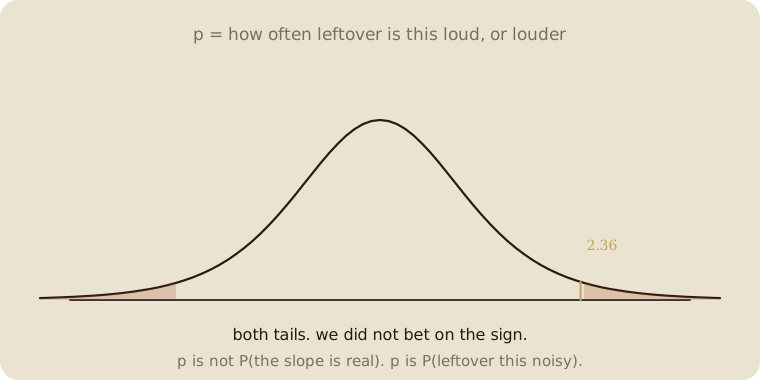
Mean vs 5: p = 0.71. Leftover this quiet is ordinary.
Slope vs 0: p = 8.3×10⁻⁵. Leftover this loud is a freak — if hours truly did nothing, and the bell is honest.
p is not P(the slope is real). p is P(leftover this noisy | boring story). Flip that in your head and you get a religion. Keep the definition.
0.05 is a habit, not a law. Same politics as logistic’s 0.5 cut.
Page 5 — The interval is the honest twin
A confidence interval is the set of boring stories leftover still fits.
Slope: 1.00 ± (2.45 × 0.11) → 0.74 to 1.26. Zero is not in it. Hours-do-nothing does not fit.
Mean: 5.25 ± (2.36 × 0.65) → 3.72 to 6.78. Five is in it. About-average still fits.
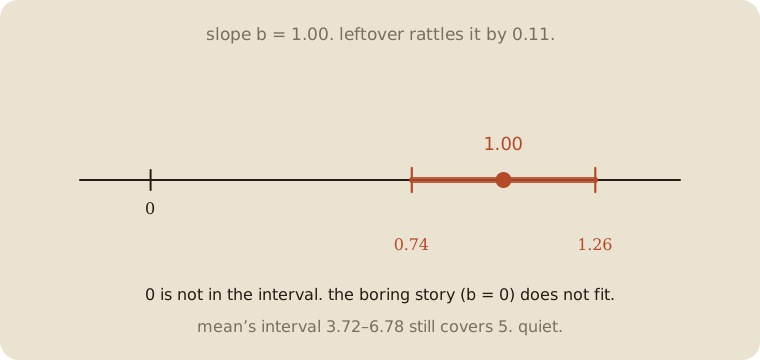
Same leftover, two knobs. The interval is the picture you can screenshot. p is a tail of that picture.
Light vs heavy study (hours ≤ 3 vs ≥ 4): means 3.75 vs 6.75, t = 4.43, p = 0.004. A two-sample cousin. Same ratio. You split the class; you did not invent a new test.
If the two piles have different spread, do not pretend they share σ. People call the fix Welch. Same t idea, a messier df. Ranks instead of a bell (Mann–Whitney) is a later camera — this notebook stays on the costume you guessed.
Page 6 — Mini recipe
- Name the boring story (mean = 5, b = 0, two groups equal).
- Guess the costume (01 distributions). Bell for this notebook.
- Compute t = (saw − boring) / se.
- Read p as leftover’s tail, not as a medal.
- Prefer the interval. Does the boring number sit inside?
- Eight dots make a fat t. More people, skinnier se, louder t for the same b.
If you keep only one thing:
t is signal over leftover-rattle. p is how often leftover shouts that loud.
Page 7 — Eight grades, in scipy
Same table as linear regression. Mean vs 5, slope vs 0, and the two groups. No extra story.
import numpy as np
from scipy import stats

hours = np.array([1, 2, 2, 3, 4, 5, 5, 6], float)
grade = np.array([3, 4, 3, 5, 6, 7, 6, 8], float)

mean = grade.mean()
se_mean = grade.std(ddof=1) / np.sqrt(len(grade))
t5, p5 = stats.ttest_1samp(grade, 5.0)
lr = stats.linregress(hours, grade)
tcrit_m = stats.t.ppf(0.975, 7)
tcrit_b = stats.t.ppf(0.975, 6)
light = grade[hours <= 3]
heavy = grade[hours >= 4]
t2, p2 = stats.ttest_ind(heavy, light)

print("n", len(grade), "  mean", round(mean, 2), "  sd", round(grade.std(ddof=1), 2), "  se", round(se_mean, 2))
print("H0 mean=5   t", round(t5, 2), "  p", round(p5, 2))
print("95% CI mean", round(mean - tcrit_m * se_mean, 2), round(mean + tcrit_m * se_mean, 2))
print("slope b", round(lr.slope, 2), "  se", round(lr.stderr, 2),
      "  t", round(lr.slope / lr.stderr, 2), "  p", f"{lr.pvalue:.1e}")
print("95% CI slope", round(lr.slope - tcrit_b * lr.stderr, 2),
      round(lr.slope + tcrit_b * lr.stderr, 2))
print("light/heavy means", round(light.mean(), 2), round(heavy.mean(), 2),
      "  t", round(t2, 2), "  p", round(p2, 3))
n 8 mean 5.25 sd 1.83 se 0.65
H0 mean=5 t 0.39 p 0.71
95% CI mean 3.72 6.78
slope b 1.0 se 0.11 t 9.38 p 8.3e-05
95% CI slope 0.74 1.26
light/heavy means 3.75 6.75 t 4.43 p 0.004
Mean vs 5: leftover shrugs (p = 0.71; 5 sits in 3.72–6.78). Slope vs 0: leftover would have to scream (t = 9.38; 0 is outside 0.74–1.26). Light vs heavy is the same verb on two piles.
ttest_1samp is question A. linregress already prints the slope’s t and p. ddof=1 is the honest sd (n − 1 leftover after the mean). Fake a smaller se and t gets louder — don’t. ttest_ind(..., equal_var=True) is the shared-σ cousin; Welch is equal_var=False.
Last page — cheat sheet
| word | meaning |
|---|---|
| boring story / H0 | the number leftover is asked to fake |
| se | leftover’s rattle for this knob |
| t | (saw − boring) / se |
| df | leftovers you still own (mean: n−1; slope: n−2) |
| z | same ratio when σ is known and n is huge |
| Welch | two piles, don’t share σ |
| p | tail: leftover this loud or louder |
| CI | boring numbers leftover still fits |
Use / skip
Reach for it when
- you ask whether a mean or slope could be leftover
- you guessed a bell for y
- you want a range, not a trophy p
Skip it when
- you only needed ŷ (01 linear regression)
- y is a coin or a count (01 logistic regression / 06 GLM — different tests)
- you wanted p as a moral verdict
Pays you: the chance wing’s first test. Same leftover as the line, now used as a judge. Interval and t are twins.
Costs you: the bell is a guess. Eight people make a fat t. p is not P(true). Pattern of leftover, not cause (that wing is later).
Inference 01. Same eight grades, now with a judge. The pile without a bell: 02 bootstrap. Three piles next: 03 ANOVA. The fork: 01 confounding. Chance costume still: 01 distributions.