ARIMAX — a sketchbook
In one sentence
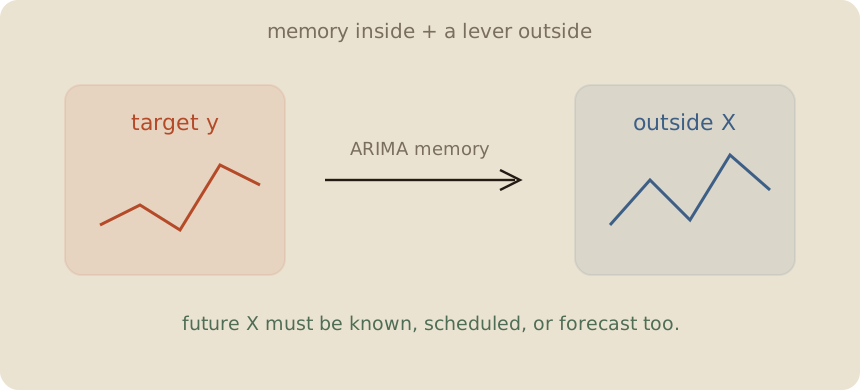
ARIMAX is ARIMA with an outside lever: the series keeps its own memory, while a predictor explains movement — but you must know that predictor in the future.
Read 01 lag trend season, 02 forecasting, and 03 ARIMA first. This is the short bridge from “the past echoes” to “the calendar or a known input also helps.”
Page 1 — The X is outside
ARIMA listens to the series itself. ARIMAX adds an X:
- temperature helps predict energy use
- ad spend helps predict sales
- planned office hours help predict study hours
The X is not automatically a cause. It is a predictor. A predictor can be useful and still be a passenger of a third force (01 confounding).
Page 2 — Known later or forecast later
To forecast next month with ARIMAX, you need next month’s X.
There are only three honest options:
- the future X is fixed by a schedule
- the future X is known from another system
- you forecast X too, and carry that uncertainty into y
If you train with a future lever but do not have it when you deploy, the model has been shown a cheat sheet.
This is the same humility as 02 forecasting: test the path you can actually produce.
Page 3 — Memory plus lever
The small picture is:
The b x part is the outside lever. The φ e part is the old miss echoing.
ARIMAX asks two questions at once:
- does X explain the series after time furniture is present?
- does leftover memory remain after X is included?
Do not read b as a causal effect without a causal design.
Page 4 — Not the same as a control series
An ARIMAX predictor and the control in 03 control series can look similar. Their jobs differ. ARIMAX is an ordinary forecasting tool; 02 causal impact uses a control to build a special no-intervention forecast.
| thing | job |
|---|---|
| ARIMAX X | improve a forecast |
| causal control | help construct the would-have without the intervention |
| future X | must be known or forecastable |
| unaffected control | must not receive the intervention |
The same series can serve both roles only if it passes both sets of checks. “It predicts well” is not “it is a valid causal control.”
Page 5 — Mini recipe
- Name the target and the outside X.
- Ask whether future X is available at forecast time.
- Fit trend / season, X, and leftover memory on the past.
- Hold out later weeks.
- Compare ARIMAX with ARIMA and a naive baseline.
- Report the horizon and the X scenario.
- Do not call b causal without the fork from 01 confounding.
If you keep only one thing:
ARIMAX needs tomorrow’s X to predict tomorrow’s y.
Page 6 — Known office hours, in numpy
The outside X is a planned number of office-hours slots. It is known for the future. The target also keeps an AR echo. We compare an AR-style model without X to one with X.
import numpy as np

rng = np.random.default_rng(7)
n = 24
t = np.arange(n, dtype=float)
season = np.array([0.8, 0.4, 0.1, -1.4] * 6)
x = np.array([0, 1, 1, 0, 0, 1, 0, 0] * 3, dtype=float)
y = np.zeros(n)
noise = rng.normal(0, 0.20, n)
phi_true = 0.45
for i in range(n):
    base = 3.0 + 0.08 * t[i] + season[i] + 0.80 * x[i]
    lag = 0.0 if i == 0 else (y[i - 1] - (3.0 + 0.08 * t[i - 1] + season[i - 1] + 0.80 * x[i - 1]))
    y[i] = base + phi_true * lag + noise[i]

cut = 20
dummies = np.eye(4)[np.arange(n) % 4][:, :3]
def design(include_x):
    pieces = [np.ones(n), t, dummies.T[0], dummies.T[1], dummies.T[2]]
    if include_x:
        pieces.append(x)
    return np.column_stack(pieces)

def forecast(include_x):
    X = design(include_x)
    beta = np.linalg.lstsq(X[:cut], y[:cut], rcond=None)[0]
    resid = y[:cut] - X[:cut] @ beta
    phi = np.dot(resid[1:], resid[:-1]) / np.dot(resid[:-1], resid[:-1])
    path = []
    echo = resid[-1]
    for i in range(cut, n):
        echo = phi * echo
        path.append(X[i] @ beta + echo)
    return np.array(path), beta[-1] if include_x else 0.0

actual = y[cut:]
arima, _ = forecast(False)
arimax, x_beta = forecast(True)
print("actual", np.round(actual, 2))
print("ARIMA-style", np.round(arima, 2), "MAE", round(np.abs(arima - actual).mean(), 2))
print("ARIMAX", np.round(arimax, 2), "MAE", round(np.abs(arimax - actual).mean(), 2))
print("estimated X coefficient", round(x_beta, 2), "  planned future X", x[cut:].astype(int).tolist())
actual [4.82 5.57 4.47 3.32]
ARIMA-style [5.17 5.58 5.05 3.23] MAE 0.26
ARIMAX [5.01 5.5 4.56 3.21] MAE 0.12
estimated X coefficient 0.74 planned future X [0, 1, 0, 0]
The known schedule helps ARIMAX beat the no-X version. Change the future X scenario and the forecast changes. That is useful, but it is also a responsibility: report which X you assumed.
Last page — cheat sheet
| word | meaning |
|---|---|
| X | outside predictor |
| ARIMAX | ARIMA plus outside predictors |
| dynamic regression | another name for regression with time-memory leftovers |
| future X | known, scheduled, or forecast separately |
| coefficient | predictive lever, not automatically causal effect |
| scenario | the future X path you assumed |
Use / skip
Reach for it when
- an outside input is genuinely available in the future
- it improves later holdout error beyond ARIMA / baseline
- you can state the future X scenario
Skip it when
- X is only known after y arrives
- you are calling prediction a causal effect
- X is contaminated by the intervention (03 control series)
Pays you: forecasts that respond to a known plan or outside signal.
Costs you: future X is another forecast or assumption. A strong coefficient can still be confounding.
Time 04. ARIMA remembers the series. ARIMAX also listens to a future-known lever. Forecast first; explain causally only with more design.