Datazines — a sketchbook for data science
In one sentence
Short, visual guides to data science: one idea, one picture, and one honest example at a time.
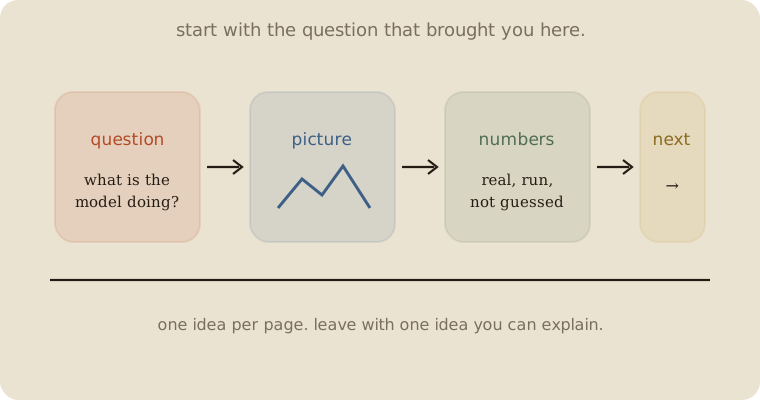
Data science has a lot of names. This is the part you can hold in your head.
No course registration. No required route. Start with the question that brought you here.
Start with a question
“What does a model learn from a number?”
Start with 01 linear regression. A cloud of exam results becomes a line. The line makes a guess; the leftover shows where it missed.
“Will it work on someone new?”
Open 01 train test validate. A model can look clever on the people it has already seen. This is how you check the leftover on new people.
“Is the answer yes or no?”
Read 01 logistic regression. The line stays inside, but the answer comes out as a probability: pass or fail, spam or not spam.
“How do models learn?”
Take 01 gradient descent. Picture a bowl, take a step downhill, and change the knobs a little at a time.
“How do LLMs work?”
Follow the short staircase: 01 neural net → 02 embeddings → 03 attention → 04 LLM. The last stop is next-token prediction, not magic.
What is inside
Predict — lines, probabilities, trees, forests, and margins. Start with 01 linear regression or 01 logistic regression.
Learn — gradient descent, a tiny neural net, embeddings, attention, and LLMs. Start with 01 gradient descent or 01 neural net.
Check — train/test splits, bias and variance, metrics, t-tests, and bootstrap. Start with 01 train test validate.
See the world differently — distributions, causes, time, PCA, and clusters. Start with 01 distributions, 01 confounding, 01 lag trend season, or 01 PCA.
Choose and act — priors, MCMC, rewards, bandits, and Q values. Start with 01 prior or 01 the loop.
How to read a zine
Every zine is a small notebook:
- A picture comes before the formula.
- The idea gets one plain-English sentence.
- Real numbers keep the story honest.
- The last page says when to use the method — and when to skip it.
Read the first note in a sequence before its numbered sequels. The first note builds the picture; later notes change one thing: a tax, a walk, a camera, or a different kind of outcome.
You do not need to finish one subject before trying another. Follow your curiosity, then come back when a word starts to feel familiar.
The thread running through it
Most of these notes ask one quiet question:
How wrong was the guess?
The difference between what happened and what the model expected is the leftover. It can be a missed grade, a wrong prediction on a new person, a surprising next word, or the gap between what happened and what would have happened without an intervention.
The methods differ in what they do with that miss. They fit a line, tax its knobs, split the crowd, walk downhill, redraw the people, or ask whether the pattern might have another cause.
If you want a gentle first walk
- 01 linear regression — make a guess from a number.
- 01 train test validate — ask whether the guess travels.
- 01 logistic regression — turn a score into yes / no.
- 01 gradient descent — see how a model changes its knobs.
- 01 neural net — stack the same move a few times.
Then go wherever the next question points.
Cheat sheet
| if you want to… | open… |
|---|---|
| predict a number | 01 linear regression |
| predict a yes / no | 01 logistic regression |
| test a model on new people | 01 train test validate |
| understand a leftover | 01 distributions |
| learn how models change | 01 gradient descent |
| understand an LLM | 01 neural net → 04 LLM |
| ask whether a pattern is a cause | 01 confounding |
Use / skip
Reach for this page when you are new, unsure where to begin, or want the shortest route to a useful picture.
Skip it once you know the question. Open the relevant zine and start drawing.
Pick a question. Open a sketchbook. Leave with one idea you can explain.